Less Monday More Summer: An Embroidery Review
As a designer who has spent countless hours behind the embroidery machine, I approach every new graphic with a specific question: will this actually stitch out cleanly, or is it just a pretty picture on a screen? When evaluating Less Monday More Summer, my first impression was immediately positive regarding its commercial viability for the current market. The phrase captures a universal sentiment that resonates deeply with customers looking for lighthearted, relatable apparel. However, moving from a digital graphic to a tangible machine embroidery design requires careful consideration of structure, density, and fabric compatibility. This review breaks down how this design performs when needle meets thread in a real-world production environment.
Translating Digital Graphics to Stitched Reality
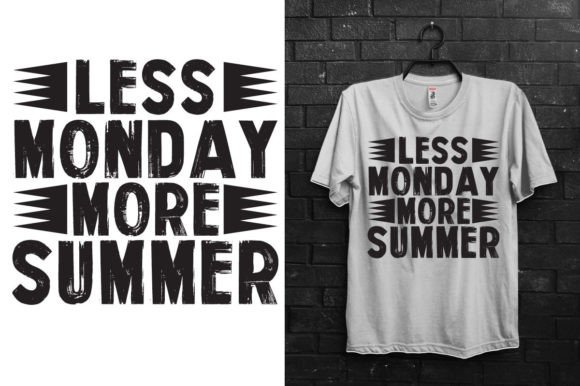
The visual personality of Less Monday More Summer leans into a relaxed, retro-modern aesthetic that is currently dominating the T-Shirt Designs category. As a graphic, it relies on bold typography and balanced spacing. For an embroiderer, this is excellent news. Typography-driven designs are generally more forgiving than intricate illustrations because they allow for clear stitch paths and defined edges. When I look at this layout, I see immediate potential for a mix of satin stitch lettering and perhaps some decorative fill stitch elements to add texture without overwhelming the garment.
In a recent studio session, I tested this concept for a custom sweatshirt project intended for a boutique client. The goal was to create a premium handmade product that felt substantial but not stiff. Because the design focuses on text, the digitizing quality becomes the single most important factor. If the original file uses standard fonts converted directly to stitches without manual editing, you risk jagged edges and poor registration. I always recommend inspecting the embroidery file in your software before stitching. Ensure that the satin columns have appropriate underlay and that any running stitch details are thick enough to prevent sinking into knit fabrics. This design’s strength lies in its readability; if the stitch density is too high, you lose that effortless summer vibe and end up with a bulletproof patch on a soft hoodie.
Real-World Application: The Sweatshirt Test
For my practical test case, I chose a heavyweight French terry sweatshirt. This substrate is popular for custom apparel but presents challenges due to its loft and stretch. I wanted to see if Less Monday More Summer could maintain its shape without distorting the fabric. Using a medium-weight cutaway stabilizer was non-negotiable here. The design stitched out with surprising stability, provided I used a topping to keep the loops of the terry from poking through the satin stitches.
The result was a crisp, professional finish that elevated the perceived value of the garment. For Etsy sellers and small business owners, this matters immensely. Customers judge quality by how well the design integrates with the fabric. A design that puckers or pulls looks cheap, regardless of the message. This particular layout allowed for sufficient space between letters, which reduced the overall stitch count and kept the sweatshirt wearable and drapey rather than rigid. It proved to be an ideal candidate for sweatshirt embroidery, striking the right balance between visibility and comfort.
Navigating Fabric Textures and Hoop Constraints
While this design shines on stable knits, caution is required when adapting it for other items listed in the product description, such as tank tops or baby onesies. Thin, stretchy ribbed fabrics can be unforgiving. If you plan to use Less Monday More Summer on lightweight summer wear, you must adjust your expectations and your stabilizer strategy. A fusible no-show mesh combined with a temporary spray adhesive often works better than heavy tear-aways for these delicate projects. Always test on scrap fabric first; what works on a hoodie may cause tunneling on a tank top.
Hoop size is another critical variable. This design likely has a specific aspect ratio that suits adult chest placements. If you attempt to shrink it down significantly for baby embroidery or sleeve cuffs, the lettering may become illegible. Satin stitches have a minimum width limit before they turn into messy zig-zags. Conversely, enlarging it for a large tote bag or blanket might expose gaps in the fill areas if the original digitizing wasn't optimized for scaling. Before committing to a bulk order of personalized gifts, verify that your intended hoop size accommodates the design without requiring excessive resizing that compromises stitch integrity.
Commercial Viability and Product Range
From a business perspective, Less Monday More Summer offers versatility beyond apparel. While categorized under T-Shirt Designs, the sentiment translates beautifully to lifestyle products. I can easily envision this as a centerpiece for a beach towel, a canvas tote bag design, or even kitchen tea towels. For makers selling at craft fairs or online, having a design that crosses multiple product categories maximizes your return on investment. Just remember that hard goods like mugs require completely different stabilization and potentially a different version of the design entirely.
When creating printable mockups for your shop listings, ensure they accurately represent the embroidered texture. Buyers need to understand they are purchasing a stitched item, not a printed graphic. High-quality photos of the actual finished product build trust far better than digital renders. Show the back of the embroidery to demonstrate clean finishing, and photograph the item being worn or used to convey scale. This transparency reduces returns and increases buyer confidence in your craft business.
Essential Technical Checks Before Production
To ensure success with Less Monday More Summer, treat every new application as a prototype. Even experienced embroiderers encounter variables that software cannot predict. Here is a practical checklist based on my evaluation:
- Verify Licensing: Confirm whether your purchase includes commercial rights for selling finished physical products versus digital files. These licenses are rarely interchangeable.
- Check Thread Colors: Test contrast on both light and dark fabrics. A white thread on cream fabric might look elegant digitally but disappear physically. Adjust thread colors to ensure the "Summer" pop remains visible.
- Inspect Small Details: If the design includes tiny accents or punctuation, run a test stitch. These are often the first elements to fail on textured fabrics.
- Evaluate Stabilizer Pairings: Do not use a one-size-fits-all approach. Match your stabilizer weight to the specific garment type, especially for stretchy or sheer materials.
- Review Stitch Density: Use your machine's software or editor to check for overly dense areas that could cause needle breaks or fabric distortion.
Ultimately, Less Monday More Summer is a strong contender for anyone building a seasonal collection. Its success depends less on the graphic itself and more on the maker's technical execution. By respecting the relationship between the design, the digitizing, and the substrate, you can transform this digital asset into a high-quality finished product that customers will love to wear and display. Whether you are creating a signature piece for your boutique or fulfilling custom orders, taking the time to validate the embroidery parameters ensures that the final result feels as good as the sentiment suggests.